From Data to Maps: How EcoCommons Helps Scientists Understand Australia's Wildlife
SBS Mandarin talks to Xiang Zhao about EcoCommons and how data science supports wildlife conservation in Australia.
In the news

SBS Mandarin (SBS 中文) featured the EcoCommons platform and my work on it in a podcast episode (11:34), presented by Olivia Yuan.
🎧 Listen to the episode (Mandarin):
You can also listen on SBS: How EcoCommons is helping scientists better understand Australia’s wildlife (SBS Chinese, 27 Aug 2026).
The episode is in Mandarin. Below is my English summary. (A Chinese version of this page is available via the language switcher.)
English summary
Protecting wildlife takes more than binoculars and field surveys. Climate, vegetation, terrain, bushfires — even where an animal has been recorded in the past — can all be important clues for working out where a species might live. In Australia, ecologists are using data, models and computing to map the potential habitats of wildlife.
When ecologists want to know where an animal might live, they need more than field observation. Data on a species’ historical distribution, climate, vegetation, terrain and bushfire history can all inform where its habitat is likely to be. But that data is often scattered across different institutions and databases, in many different formats.
An Australian research team is trying to solve this problem. EcoCommons is an online platform for ecologists, conservation practitioners and government users that brings ecological data, modelling tools and computing resources together in one place, helping people run species distribution models.
I’m a member of the EcoCommons team, mainly responsible for developing and maintaining the platform’s core software. The goal is to integrate scattered ecological data, species distribution models and computing resources so that ecologists and conservation workers can use this information for their research more easily. This work saw the team go on to win the 2026 Australian Museum Eureka Prize for Excellence in Data Platforms.
Ecological research carries a lot of technical and digital barriers. Researchers may need programming, statistics and modelling skills, and can spend a huge amount of time downloading, cleaning and converting data from different sources — often getting distracted just trying to find the right dataset in the first place.
This doesn’t mean ecologists no longer need to go into the field. Field surveys remain very important. One thing the platform does well is help researchers understand what data already exists before they set out — reducing duplicated surveys and helping them decide which areas are worth investigating further.
Take the Eastern bristlebird in eastern Australia. One population had dropped to just eight birds. After years of conservation work, that number has recovered to around 50 — but researchers still didn’t know which potential habitats in the local mountains had yet to be surveyed. Without a model, they’d have to rely more heavily on the experience of field workers or fairly random choices. With a habitat map, they have more information to help decide which places are most worth surveying.
Looking ahead, what I’d most like to see is species distribution models combined with more sophisticated environmental decision-making tools — things like systematic conservation planning and the design of species monitoring programs. A species distribution model first provides a scientific foundation: where a species is likely to be. What matters next is how we take that scientific information further, into real-world environmental management and conservation.
As an interdisciplinary researcher, my own path has shifted several times. I started out in engineering mechanics as an undergraduate, moved into environmental engineering, and gradually found my way into ecology. During my postgraduate studies I discovered I was especially drawn to statistics, modelling and programming.
“Choose the things you love to do, and choose a place you love — then you’ll find there’s a lot you can do, a lot of opportunities, and a lot of directions to grow.”
Episode: SBS Chinese (SBS 中文), presented by Olivia Yuan, 27 August 2026. Summary and translation above are my own; for the full interview please listen to the original Mandarin episode.
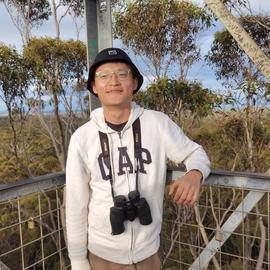
Zhao Xiang (赵 翔)
Birder/Conservation Scientist/Software developer
I’m a birder, conservation scientist, and software developer working at the intersection of ecology and code. As a Software Developer and R Specialist at QCIF, I build and maintain the EcoCommons Platform, helping researchers run species distribution models and spatial analyses at scale. I earned my MPhil at QUT, where I applied spatial and statistical modelling to biodiversity monitoring in Antarctica. Along the way I’ve tutored GIS and environmental planning, led a panda conservation project in China, and been recognised with the BirdLife International Young Conservation Leaders Award. My work centres on turning ecological questions into reproducible, well-designed tools.